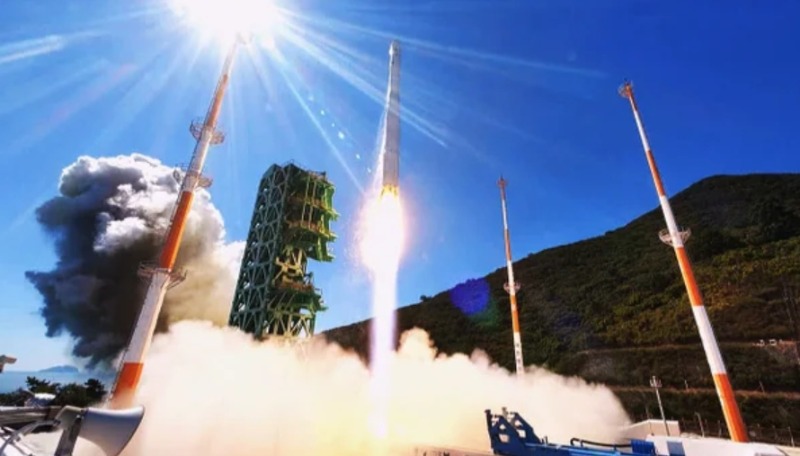
The Korean launch vehicle Nuri carried a record 15 satellites in the rocket's third stage and was launched at the scheduled time. After liftoff, the Nuri successfully separated the first and second stages and reached a target altitude of 575 km. Then, from 13 minutes 15 seconds to 2 minutes 30 seconds, five main satellite constellations were sequentially sequentially separated. The ultra-small constellation satellites are a concept of satellite internet orbiting in clusters, and the ultra-small constellation satellites launched by Nuri this time were developed by KAIST. Using the onboard electro-optical camera, it can identify objects up to 1 meter on the ground, enabling national security and disaster response activities, demonstrating the capability to send multiple satellites into space simultaneously. Oh Tae-seok, head of the Korea Aerospace Administration, said, "The successful orbital deployment of this constellation satellite demonstrates a higher level of space transportation capability, enabling various missions to be carried out according to the customer's desired orbit and schedule." Notably, this launch was the first since the launch of the Nuri rocket to proceed without a single minute late at the scheduled time, without any delays or changes in timing. Nuri will be launched at least once a year until 2032, while simultaneously reducing costs and reducing reusability. Next-generation launch vehicles are being developed, and orbital transport ships capable of performing various missions such as satellite refueling are also being promoted. Six years later, in 2032, they plan to launch a lunar lander and complete a Korean-style satellite communication network by 2035 . That's what the plan is.
Comments 0
Log in to comment.